
The Duellists.
Classic fighting styles as depicted in the movies.

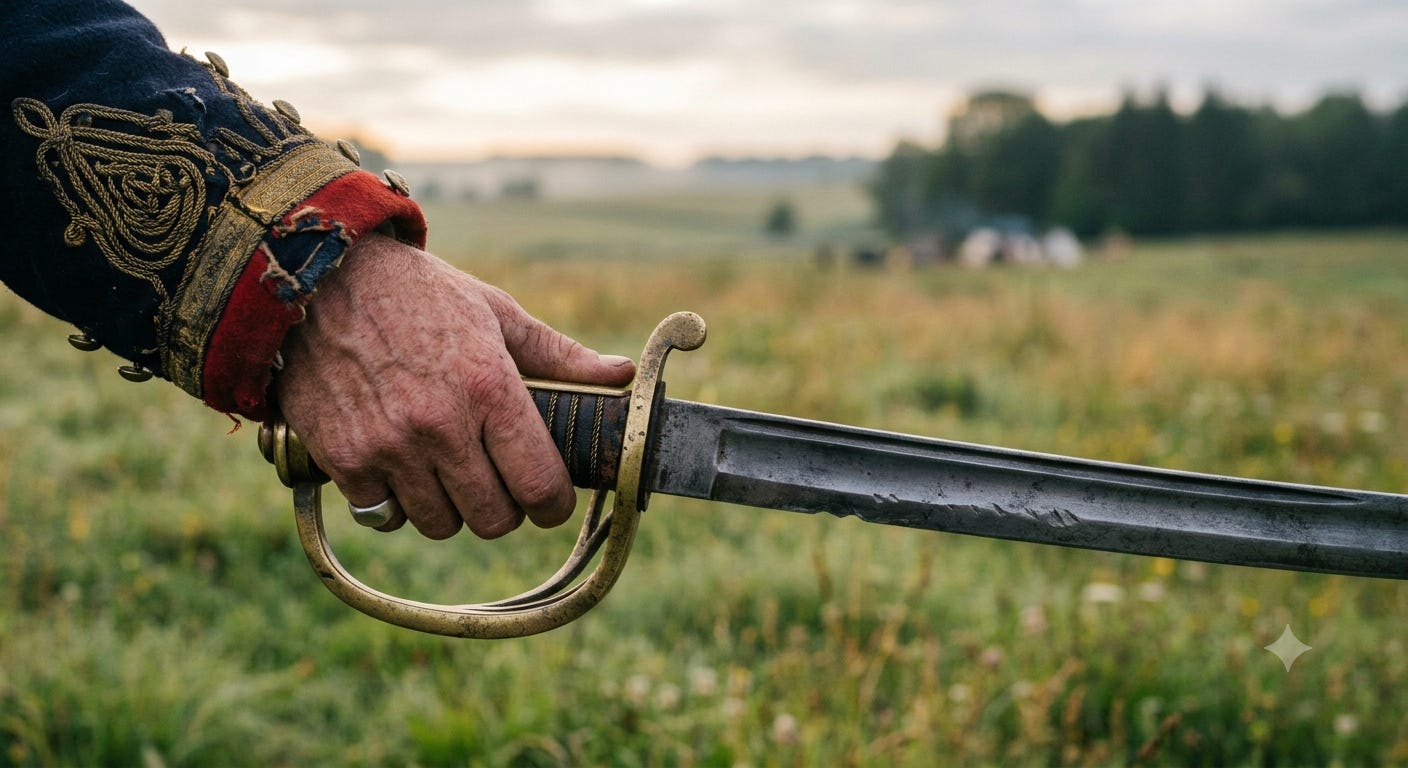
Specifically, ‘The Duellists’ and a reference to ‘Blade II’.
‘The Duellists’ 1977.
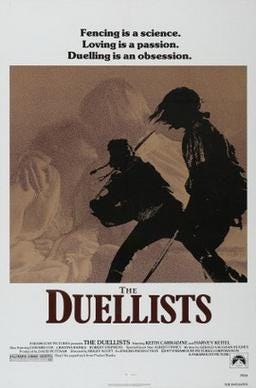
Credit: By Paramount Pictures - May be found at the following website: MoviePosterDB.com, Fair use, https://en.wikipedia.org/w/index.php?curid=13348538
A movie about violence, honour and escalating consequences. Spoiler alert; if you have already seen this movie, read on. If not, track it down, watch it and then consume these notes at your leisure. Or, you may just be interested in the depiction of what are, after all, historical martial arts as viewed through the cinema.
The Background.
In 1977 an ad man decided to jump his ambition into making full-length movies. He had originally made a well-respected TV commercial in the UK for Hovis bread; full of misty English wistfulness and nostalgia, about a delivery boy on a bike. Some people might remember it.
That ad man was Ridley Scott.
He picked up a 1908 short story by Joseph Conrad called ‘The Duel’ and put proposals forward for a full-length feature.
A large part of the success and style of the movie came from the choice of the two lead actors, the protagonists. Harvey Keitel as Gabriel Feraud and Keith Carradine as Armand d’Hubert. I am loath to use the word ‘masterpiece’ (Ridley Scott has always been so hit and miss) but the Duellists is one of his finest productions.
The structure of the Duellists is designed to be episodic, which made the story romp along at quite a pace, but it avoided repetition and predictability.
Scott plays with his audience with clever devices, such as, introducing the viewer to a messy fight scene, part way into the action. In this case, we are brought into the gory scenario by sound – the clanging of blades.
At no point in the movie are the audience ever encourages to root for Harvey Keitel’s character; a demonic moustache-twirling bully that stays just the right side of cliché. He positively burns off the screen, with his swagger and murderous impatience.
Really, the clash between the two men goes beyond honour, and to my mind it appears as an early cultural reference to what is now referred to as ‘stalking’.
D’Hubert’s romantic connections counterbalance the ambition and solitary sourness of Keitel’s Feraud.
As they both climb the ranks, almost in sync with each other, all against the Napoleonic and post-Napoleonic backdrop; Feraud almost assumes the tragic figure of Bonaparte in exile. It’s powerful stuff.
Now for the duels.
Each conflict in the Duellists was stylistically different. It was almost as if a variety of fight arrangers were employed, but that wasn’t the case.
(For the geeks: Among the weaponry used were, French Épée de Cour (Court Swords/Small Swords), French Modèle AN IX and Modèle AN XI Light Cavalry Sabres, appropriate to French Hussars and Versailles-style Flintlock Duelling Pistols, designed in the style of master gunsmith Nicolas-Noël Boutet).
An example of one of the classic and realistic duel scenes from the movie:
And Blade?
Trailer:
For me, Ridley Scott’s approach to the fight scenes in the Duellists was the forerunner of what Guillermo del Toro did in the 2002 ‘Blade II’ movie.
Del Toro in the second of the ‘Blade’ franchise, deliberately had his fight arranger/choreographer (Donnie Yen) present each set-piece in different styles of combat. This was intended to emphasise the cultural differences between the vampire factions. There were scenes designed around Western fencing, Ninja assassins and hybrid MA.
Here is Wesley Snipes in fine form against the vampire ninjas:
In Blade II, it all worked so seamlessly that the audience were not aware of the cunning sleight of hand, but were just blown away by the action.
To return to the Duellists…
With the choreography and realistic details in the Duellists I find myself wondering if the director could have pushed the envelope on the violence a little further?
Having recently done a bit of a deep dive into the Napoleonic conflicts I came across contemporary medical on-the-spot images of the kinds of injuries inflicted by cavalry sabres. It certainly was more than ‘a mere scratch’.
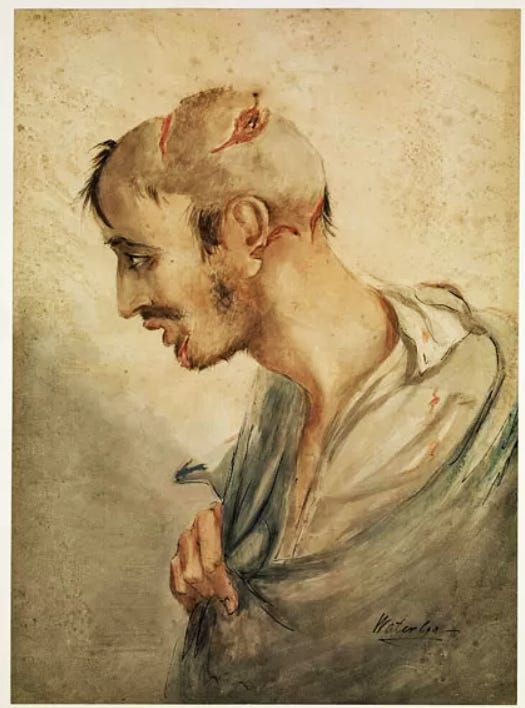
Sabre wound to head, Hopital de la Gendarmerie, 5 July, 1836. Watercolour by Charles Bell from his sketchbook. Wellcome Library reference: RAMC/95/1/1.
In reality, there were career duellists, not dissimilar to Feraud. One that comes to mind is, Donald McBane (1664–1732), a Scot who was inclined to be legendarily argumentative; although some say his life story is a little… exaggerated.
https://en.wikipedia.org/wiki/Donald_McBane
Conclusion.
For moviemakers there is still mileage in these sorts of ideas, and history is scattered with the most unbelievable characters (like McBane).
Look up the gender-bending Julie d’Aubigny (1673–1707). That story has only made it into film once; ‘Madamigella di Maupin’ 1966 Italy.
Details of her life: https://en.wikipedia.org/wiki/Julie_d%27Aubigny
The filmmakers throw up images of the romanticism and the action, but despite the gloss, for martial artists you can still read between the lines and appreciate the mortal danger within the story. This was, for me, the success of the movie ‘The Duellists’.
If you have seen it before, watch it again (I did recently). If you haven’t, chase it down, it’s worth the effort.