
Raw.
Scars that should never see the light of day.

There’s a thing in combat sports, where it’s said that you never forget anyone who puts a scar on your face.1
In over fifty years of karate training, I have only picked up two facial scars. One was my chin split by a gyakuzuki I didn’t see coming, and the other was in a wild scrappy exchange where someone’s thumbnail gouged a chunk out of my eye (a lot of blood on that one).
Every time I look in the shaving mirror, I remember the two individuals who gave me those permanent marks (though they have faded with time and age).
But one significant scar I never have to look at. Here is the story of how that particular memento was acquired.
September 1999.
In the autumn of 1999 I was invited to attend a training course in Okinawan Pang Gai Noon Ryu karate (Uechi Ryu, a Naha school of training loosely related and similar to Goju Ryu). The training was taken by a visiting American Sensei.
At that time, I was engaging in a fascination with the Okinawan root of karate, and had previously enjoyed training regularly with an Okinawan Goju group associated with Miyazato Sensei. (see my piece: https://budojourneyman.substack.com/p/climbing-someone-elses-hill-to-look ).
Eventually, over the course of many years, my interest in Okinawan karate diminished, as I realised it was the wrong rabbit to chase.
Shihan Mary Boltz.
But to return to the story; the American Sensei was well qualified and she had worked extensively with Nishiuchi Mikio Sensei, over in the States. She was also in the UK to teach Okinawan weapons (Kobudo) for the next day, but Kobudo, (of that methodology), has always held zero interest for me, so I skipped that.
It was a strange set-up for a course. It had been organised by Albie O’Connor, chief instructor at Sessen Ryu, and the invite came to me through one of his Kobudo students, Carl O’Malley, who also trained with me.
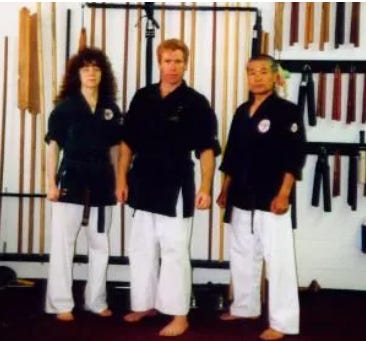
Albie O’Connor with Mary Boltz and Nishiuchi Sensei in the States.
Albie seemed to have drawn people in from far and wide, so it was well-attended, though a community room at a football club in Corringham wasn’t the best choice for a venue, but in those days we just made do. There were no changing rooms (unusual for a football club) and the function room was badly lit. But, it still worked.2
However, none of this dimmed the enthusiasm of Shihan Mary Boltz.
She hit the ground running with a warm-up that was off the scale, although I hesitate to call it a ‘warm-up’. It was more like, over-the-top callisthenics, military-style P.T.
Sometimes particular teachers have a ‘party piece’, and this was clearly hers.
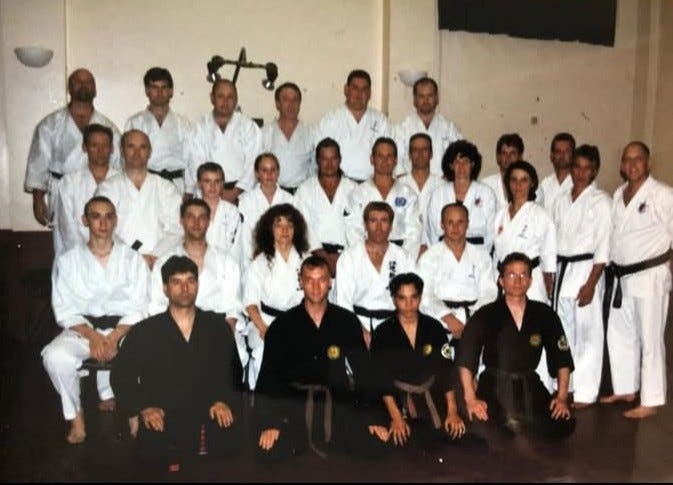
Photo of the day, with thanks to Jill O’Connor. Myself, extreme left, second from back row. Carl O’Malley, first row seated, second from the left. On his left, Shihan Boltz and then Albie O’Connor Sensei.
Let the pain begin.
For the sake of brevity, I won’t give details about the number and type of exercises we were subjected to; except one…
The sit-ups.
Not even crunches; just good old-fashioned partnered locked-leg sit-ups.
Carl and I entwined legs in a seated position, and Boltz Sensei said that each person had to call out the count. Looking around the room, if she was serious, this was going to be a very large number of sit-ups.
The general reality about sit-ups, as an exercise.
Years back I had figured out how sit-ups worked, and knew that they had nothing to do with washboard abs. Although, at that time, I didn’t know the precise anatomical details, I was aware that the workload is shifted away from the abs and into the hip flexors and the psoas muscle.3
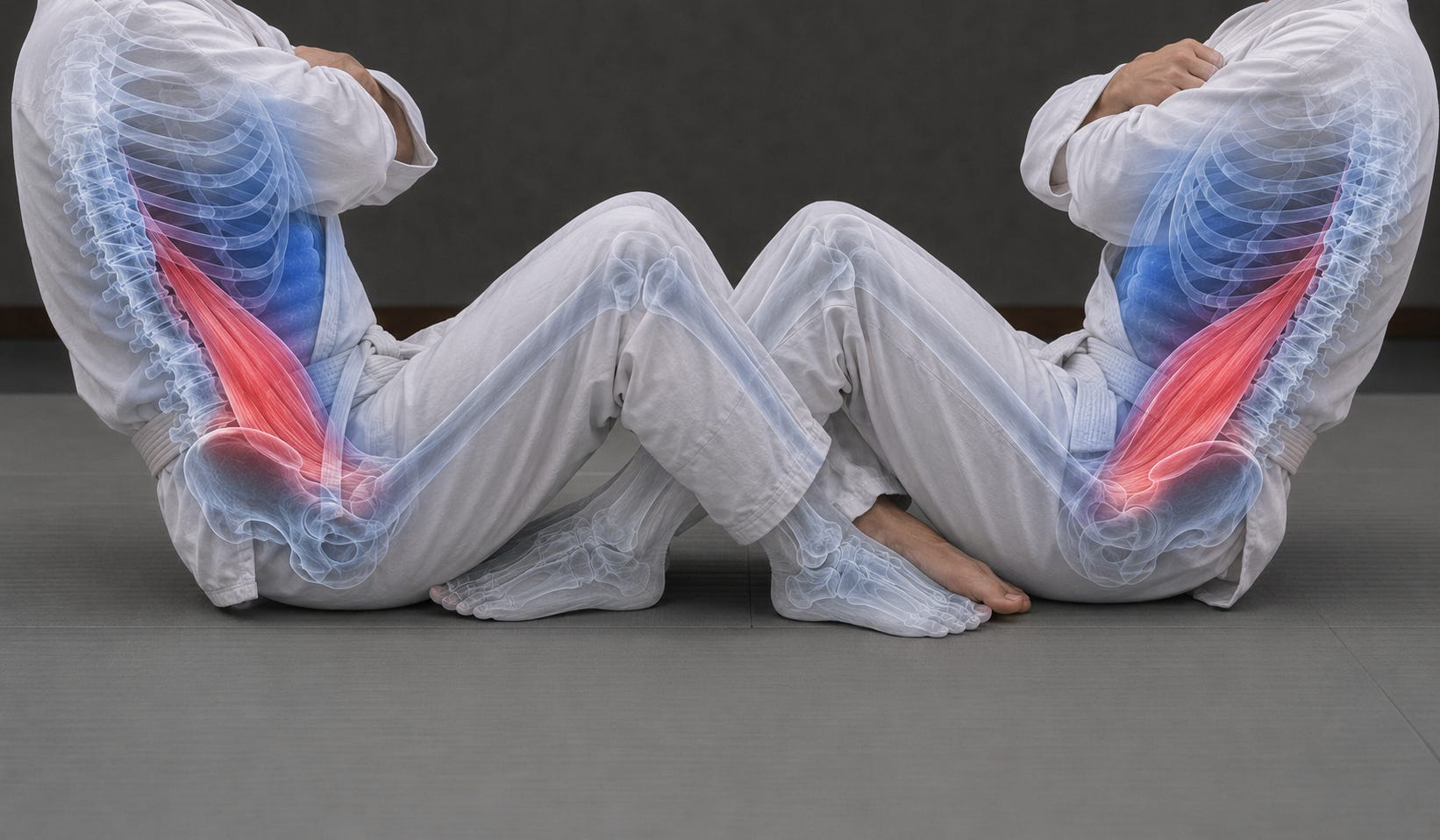
Psoas and hip flexors, but not really abs.
We now know that doing abdominal exercises in that manner is risky training, with a high possibility of incurring long-term damage, sometimes resulting in high shear and compression forces on the lumbar discs.4
So off we went….
We just ripped into it and tried to establish a rhythm, that later on, got all the more difficult as those who were calling out were struggling to breathe.
In my journal I commented on how the look of pain on Carl’s face just spurred me on.
I recently recounted this story to someone, a non-martial arts person, and he said, “Why didn’t you just rebel and tell them it was stupid?” The answer to that comes in several parts. Firstly, even though we could take an educated guess, we didn’t know how far this would go. Secondly, male pride wasn’t going to wimp out on this one. Thirdly, we are tough martial arts people (ironic). And finally, Mary Boltz was doing the exercises alongside us (although, later on she somehow declined to join us on the press-ups).
During the sit-ups, did we sweat? You bet we did. In fact, it was the sweat that made things worse. Sitting in a puddle of our own bodily fluids was just compounding the problems.
The pain came not from the exhaustion, but the friction.
Repetitive rubbing on the tailbone by wet harsh cotton was like sandpaper to your ass. But still the tempo drove us on. Some people were flagging after the first seventy-five; it just seemed to go on for ever…. And then, abruptly, it was over.
Carl had been keeping a count, and he concluded that we had done five-hundred sit-ups.
Yes, 500, let that sink in for a second…
Damage recovery.
I think we pretended, in that very English way, like it had never happened and we stoically kept our stiff upper lips in place for the rest of the four-hour session.
Getting changed after training, the blood on my keikogi testified to the fragility of the flesh. (At home, in the bathroom mirror… ouch).
To return to Boltz Sensei’s lesson: In my journal I have notes and sketched diagrams that explained some of the Uechi Ryu methodology. Disappointingly, we did no kata, but relied very much on Sanchin Dachi and open-handed techniques.
A demonstration of Goju Ryu Sanchin Dachi training.
There was one gung-ho leg capture and sweep which caused some poor guy to limp off with what looked like an adductor tear, or at least a bad pull; he could hardly walk.
Retrospectively.
Very recently, Carl whispered to me, ‘Have you still got the scar?’. Honestly, I haven’t looked (and neither has anyone else).
Thinking about it, it’s weird what we accepted as normal. Exercises like the locked-leg sit-up existed in a blurred zone, somewhere between testing resilience and just plain punishment.
Instructors sometimes have their pet exercises, used to signal their authority, but it occasionally backfires (see my article about experiencing another American master and his ‘Ude Tanren’ challenge; https://budojourneyman.substack.com/p/the-most-peculiar-martial-arts-course )
Conclusion.
Being completely objective – apart from the scar, what exactly did I get from this experience? Maybe, it could be argued that I found something out about myself? Perhaps I could come out with the often-used platitude, attribute to Nietzsche, ‘That which does not kill me makes me stronger’, but it’s a quote that is shot through with holes.
Maybe, the whole thing was just best left in the shadows…. of my butt crack?
P.S. Apologies for the over-sharing.
A belated thank you to Albie O’Connor Sensei. He was generous enough to invite me to more than just this one event involving visiting instructors, for that I am very grateful.
Due credit also for the header image to the great master Michelangelo and his sublime ‘David’ statue.
In UK razor gangs of the 1950’s and 60’s, the deliberate scarring of the enemy’s face was a nasty and spiteful objective. Scars on the face also feature in antiquated Prussian-style fencing.
My journal record from the day gives a very detailed account.
The Psoas is the only muscle bridge that connects your upper body to your lower body. It can’t be seen, it’s so deep inside.
I am probably paying the price now, for those years of training in this way.