

In his book about training in Shotokan karate in Japan, Richard Amos subverted the usual understanding of the ‘3 K’s’ of karate (Kihon, Kata and Kumite) and said that the Japanese public generally saw karate as a different ‘3 K’s’:
· Kitsui (きつい): Hard / Demanding / Exhausting.
· Kiken (危険): Dangerous.
· Kitanai (汚い): Dirty.
It looks like karate has an image problem.
Social understanding.
This just reinforced something I had heard earlier.
I was first introduced to this idea by my good friend Mike Cundy, a long-standing Kyudo (archery) practitioner, who had lived in Japan in the 1970’s (see my two-part interview with Mike. The Bow and the Brush. Part 1. - by Tim Shaw ).
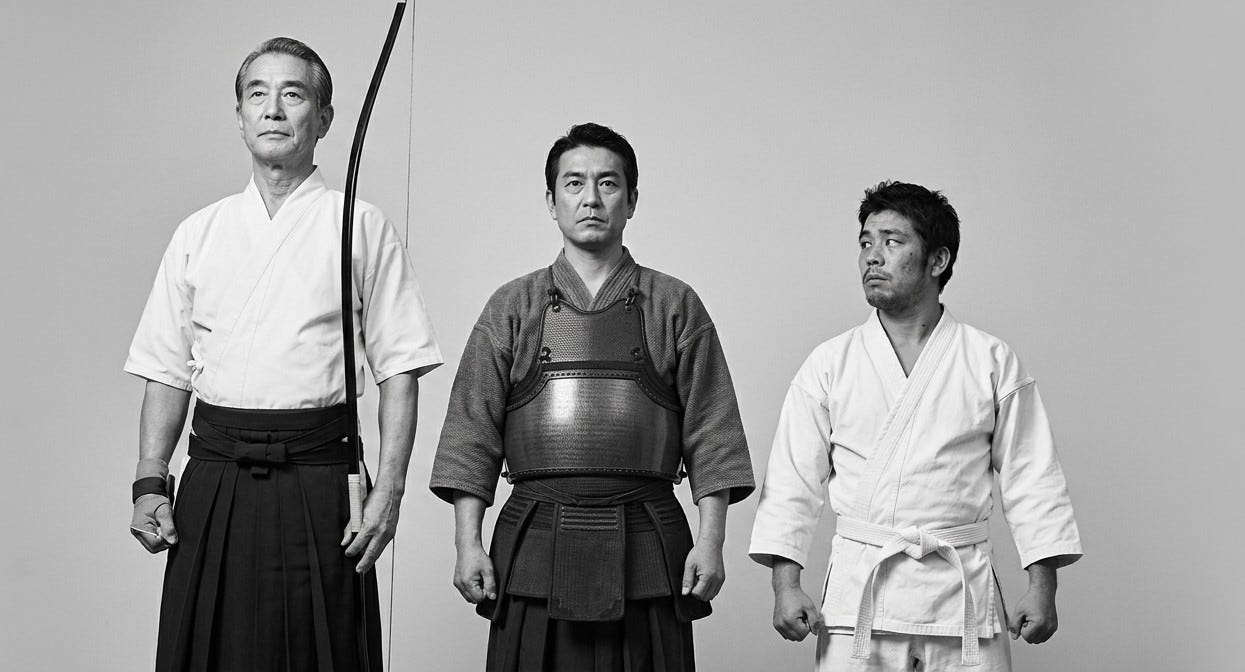
He explained that there was a distinct social hierarchy in the image of martial arts in Japan. Put simply; you had Iaido and Kyudo at the top, and at the very bottom, the potentially thuggish karate guys. (I will dig into this a little later).
Why does the arts of sword drawing and archery sit at the top of the tree?
It’s simple. These two disciplines have the opposite of an image problem. Here’s a few of their positive points:
· Historical high-status association with an aristocratic Samurai past.
· High aesthetic value.
· Deep spiritual and intellectual credentials.
· Relatively high profile, despite its throwback historical connections.
· Likely to be engaged in by people in the higher socio-economic category.
· (Linked to the above) can include expensive kit.
Add to that, both disciplines involve zero contact. Unless you are incredibly clumsy, it is extremely unlikely you will have the embarrassing problem of having to appear before a high-level board meeting with a black eye.
These people give off the aura of having a cultured refinement, and, in a way, their arts are very performative and make a clear social statement.
The two arts are entirely devoid of any practical modern age fighting function. However, they have allowed a competitive factor to creep in, but judged on pure precision, control and form (notice, no creative interpretation, this is not Ice Dance). It is purely for the specialists. Casual viewers would just wonder what the heck was going on?
Iaido competition from thirteen years ago.
Where do Kendo and Judo fit in all of this?
Both of these Gendai Budo disciplines attract similar mid-range demographics (but not top tier).
There is a clear historical link with the Japanese police force and the military, and they are still part of the culture of both areas (healthy for competition and sporting rivalries). Add to that how both kendo and judo are slotted into the school curriculum.
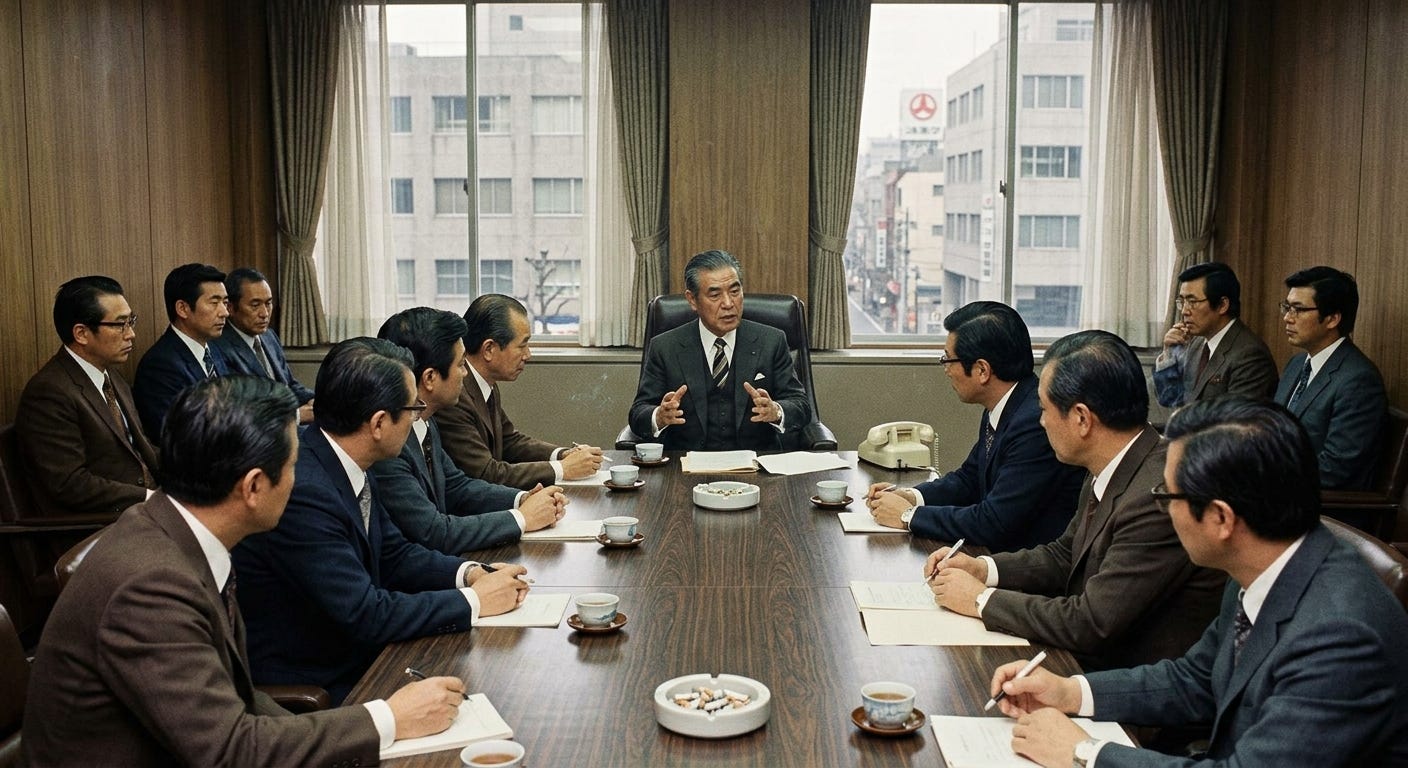
It’s not quite the elite of the Kyudo/Iaido people, but civilian practitioners are well-placed for career advancement through association with both kendo and judo. Success in those areas seems to indicate a certain brand of fortitude and discipline that can be mirrored in leadership in the workplace. It could be said that the rigid corporate structure in this area of Gendai Budo is replicated in the management organisations of many Japanese businesses.
Who’s the boss?
The bottom line is that both disciplines carry very little negative bias in the public eye. The only issues that the modern Japanese have with both kendo and judo is that the Sempai/Kohai model is now being re-evaluated in line with more liberal and progressive ideas. But, I somehow doubt that will fizzle out anytime soon. Also, with Judo, there have been some safety concerns at school level, 1 but these seem to come from the same direction as the recent safety concerns which are being voiced about school rugby in the UK. Just don’t let Japanese kids anywhere near oafish ex-Brit Prime Ministers:
And now for Karate.
The background.
Believe it or not, it seems ridiculous to many Japanese people that anyone would train for self-defence, 2 because those situations are so rare in Japan. 3
So, to the average Japanese, what is karate’s purpose? The main answer they can reach for is to compete in a sporting format.
This mentality heavily influences the perception of karate in the public’s mind. Karate’s utility seems to lean into the ‘building character’ mindset.
For kids?
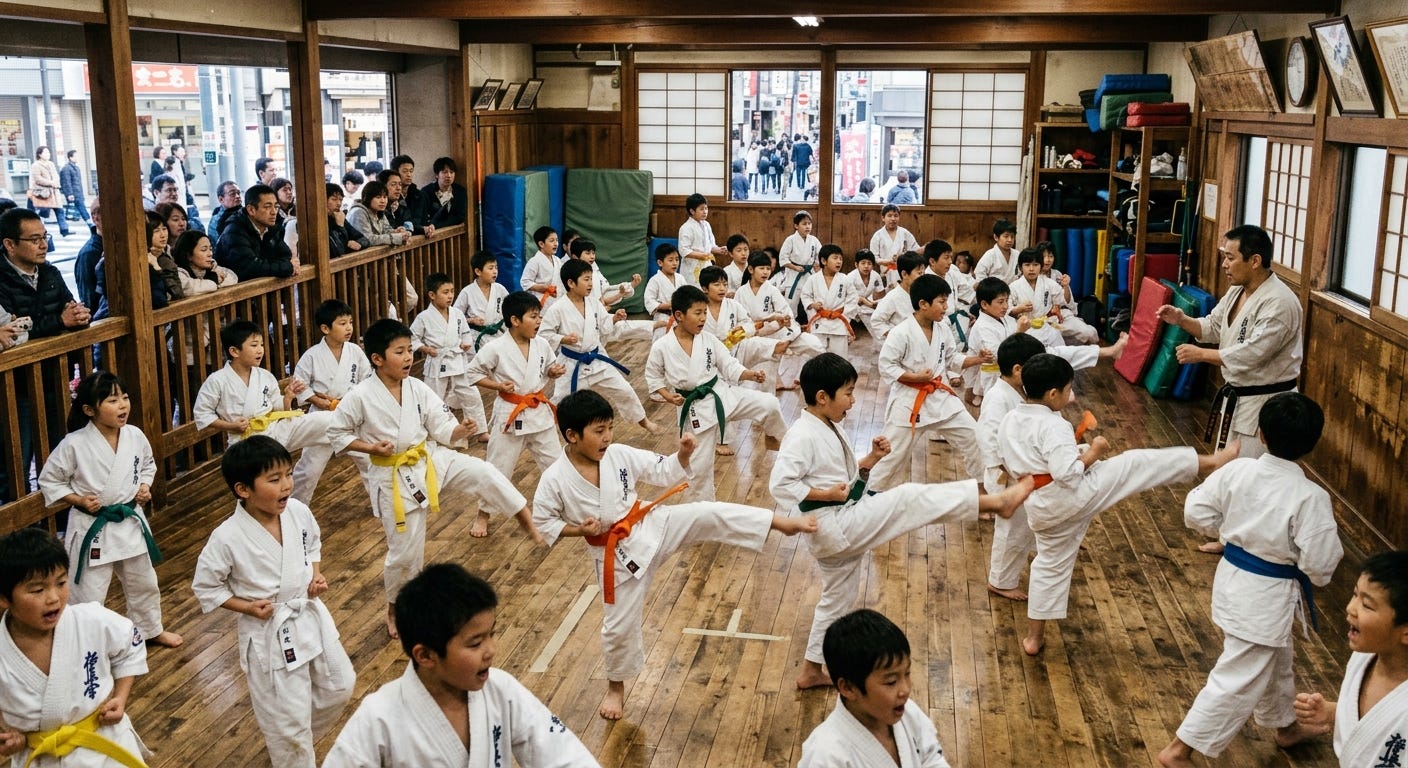
In Japan, the general perception is that one aspect of karate is that it is for the kids, a kind of after-school daycare activity. This encourages business-minded entrepreneurs, who realise they can make money out in kiddie-focussed karate activities.
For thugs?
The other side of it is that from various directions the Japanese public’s perception of karate has been less than glowing. You can go right back to the mid-20th century when hazing and over-enthusiasm of the Sempai/Kohai methodology in Japanese university went too far and people died. Things just went over the top. (An example of which I mentioned in the footnotes on my piece, ‘Exercise as punishment’ Exercises as punishment. - by Tim Shaw - Budo Journeyman).
As recently as 2021, a very public incident put a further stain on the reputation of karate, when Japanese female Olympic kumite competitor Uekusa Ayumi went public on physical assaults and mental cruelty inflicted on her by coaching director Kagawa Masao (who previous to this, had been Shotokan’s golden boy). https://mainichi.jp/english/articles/20210329/p2a/00m/0sp/006000c
Schools of hard knocks – Kyokushin.
Pop culture in Japan also feeds into the ‘bad boy’ image of karate.
The more ‘full contact’ systems like the Kyokushinkai have fanned the flames on this one. In particular, they never discouraged the Manga image that developed around its founder Ōyama Masutatsu, in fact they seemed to embrace it. Manga publication ‘Karate Baka Ichidai’ ran for 29 volumes and was the springboard for a 47-episode Anime series.
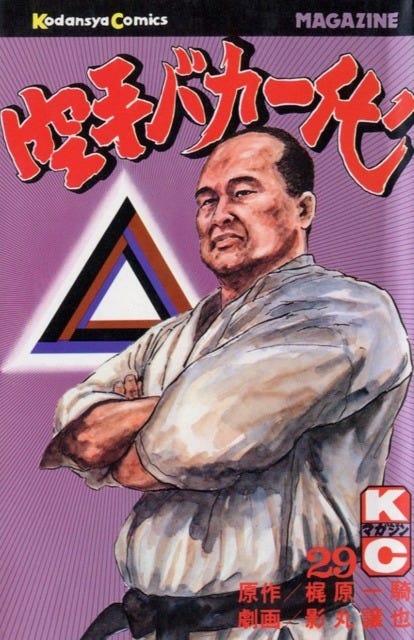
This pop-culture image did nothing for the positive public perception of karate. The blow-back was that it seemed to glorify thuggery, street violence and delinquency. Some said that prior to this, the image that karate might perhaps be a more refined activity, with bouts of controlled contact, with hard-won connections to elite universities, suffered a real knock-back.
Karate style by style.
Is there a difference between how the different styles are seen? It depends who you listen to. Western martial artists seem to think that karate is at the forefront of social and sports awareness inside Japan – it isn’t. Other sports have long-since eclipsed karate as an activity. So talking about style-awareness is not straightforward. But, gleaned from various sources, I will attempt a rundown.
· Shotokan – corporate, reasonably respectable and mainstream. It has a leaning towards a form of standardisation that has appeal in certain Japanese business circles. It has/had solid university connections. Despite what they want to tell you, it’s thought of as ‘safe’ (particularly when compared with Kyokushin).
· Wado – despite its hybrid origins, is considered rather niche, but enjoys its distinctive Japanese identity (something master Otsuka was adamant about). It prides itself as not being ‘clash on clash’ like the other styles, and this keeps it clear of the thug and brutality taint. Wado is considered more intellectual and thus attracts a certain level of white-collar worker, or even academics who are drawn towards its cerebral approach and classical Budo thinking.
· Shito Ryu and Goju Ryu – tend to attract traditionalists and historically conservative thinkers. Ones who appreciate the tradition and embrace the Okinawan roots, rather than Japanising karate and turning it into a corporation or commodity. Generally associated with the family run Dojo, very much concerned with lineage and digging back into the past.
Conclusion.
As mentioned above, this is not such a big deal in Japan. It’s just another area of the multi-facetted Japanese social mix. For over 150 years Japan has been in a battle with itself over its past and its future and with each generation it seems that the past is fading away faster than you would think. And as for the martial arts; author Robert Twigger summed it up in ‘Angry White Pyjamas’ with this quote from the book, “Sara thought martial arts were pretty silly. To a trendy young Japanese, aikido was about as sexy as Morris Dancing”.
There is nothing sexy about a sweat-soaked keikogi.
Reports revealed that over 120 school-aged children died from Judo-related head and neck injuries in Japan between 1983 and 2016. Source: a 2020 article in Japan Today. Also see this article on abuse in judo: https://www.koreatimes.co.kr/sports/20201009/judo-in-japan-getting-unwanted-scrutiny-for-abuse-violence
More progressive and outward-looking Japanese might have some awareness that outside of Japan, if you travel the world, there are more dangerous places, where violent encounters could occur. Nearer to home, I am reminded of an incident with a Norwegian karateka who came to train on a course with us, and in the lively Saturday evening vibe it all kicked off in a crowded pub. We were not directly involved, but the next day our Scandinavian visitor was boasting about witnessing, ‘A real English barfight!’ ‘I’m still picking broken glass out of my shoes!’ he said. A fresh experience for him.
Japanese crime statistics of physical assaults (not domestic) are really rare. The only ‘physical assaults’ tend to be of groping in crowded public spaces.
I was listening to a pod interview Amos did and he never mentioned this aspect, perhaps he was unaware. Ive read his book several times. I imagine post ww2 martial arts in japan did have to undergo a period of transitition. Maybe with each generation rhat passes it does another one. Society is fluid generally.
I heard tell that the late Toru Takamizawa Sensei's parents where none too pleased about him doing karate, apparently they were of samerai descent and considered it beneath them. In Okinawa before 1900 the situation couldn't be more differnt, karate was the art of the nobility. The lower classes had nothing to do with it till Itosu got it introduced into the school system. My take is you have to view the Japanese perspective of karate partly thought the prejudised lense they viewed Okinawa with. Did karate go thought a class inversion when it became public and was introduced into to mainland Japan?